

reading time ~17 mins
- Introduction
- Images in Quran
- Images in Sunnah
- Scholars’ View
- Leaving Matters of Doubt
- Trading of Idols (الأَصْنَامِ)
- Camera Photos & Videos
- Praying with or around an image
- Images on money
- Cartoons
- Children toys of Animate beings
- Who are Angels of Mercy
- Recommendations Summarised
- Glossary
- Additional Reading
Introduction
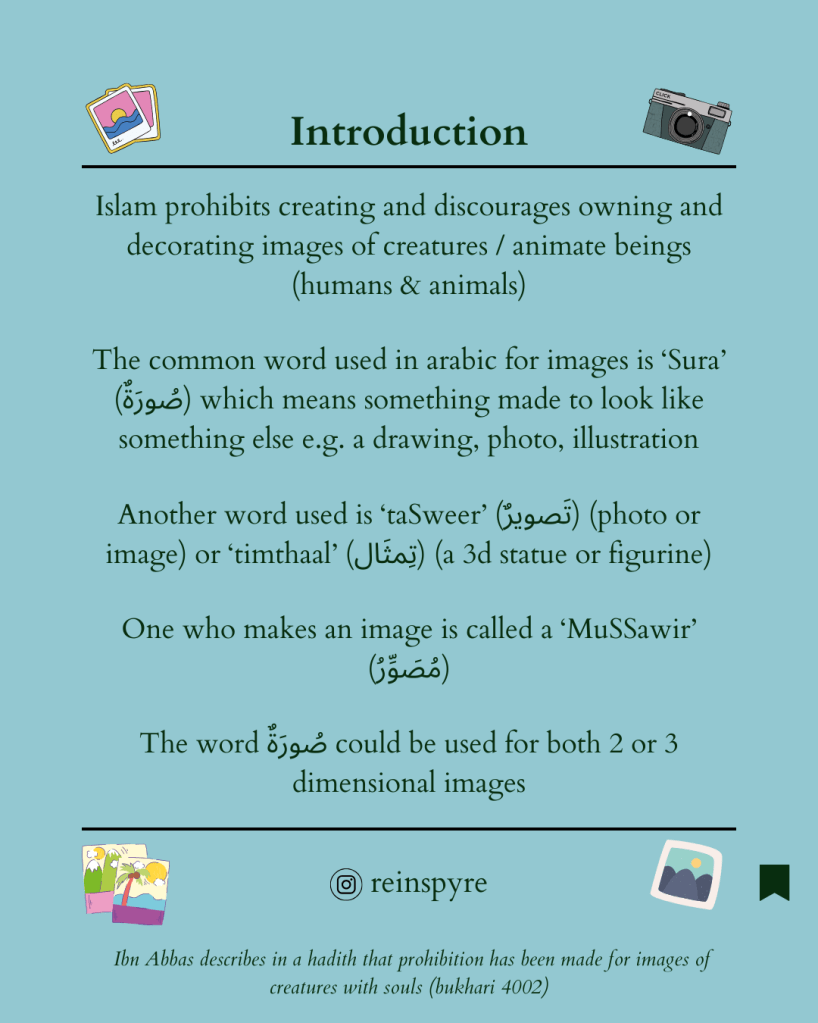
Islam prohibits creating and discourages owning and decorating images of creatures / animate beings (humans & animals). Ibn Abbas describes in a hadith that prohibition has been made for images of creatures with souls (bukhari 4002)
The common word used in Arabic for images is ‘Sura’ (صُورَةٌ) which means something made to look like something else e.g. a drawing, photo, illustration of something (it could mean a sculpture as well). Another word used is ‘taSweer’ (تَصويرٌ) (which is a photo, portrait or image) or ‘timthaal’ (تِمثَال) (usually a 3d statue or figurine). A person who makes an image is called a ‘MuSSawir’ (مُصَوِّرُ)
The word صُورَةٌ could be used for both 2 or 3 dimensional images (later referred as 2d or 3d)
It’s also important to note that the animate object rulings are applicable when the face is involved (e.g. picture of a hand is generally not problematic)
Do not confuse the word for Image Sura صُورَةٌ with a ‘sura’ (سورة) of a Quran written in Arabic with a س. This is translated by some as a chapter but has vast meaning behind the word as well. It is not in the scope of this article
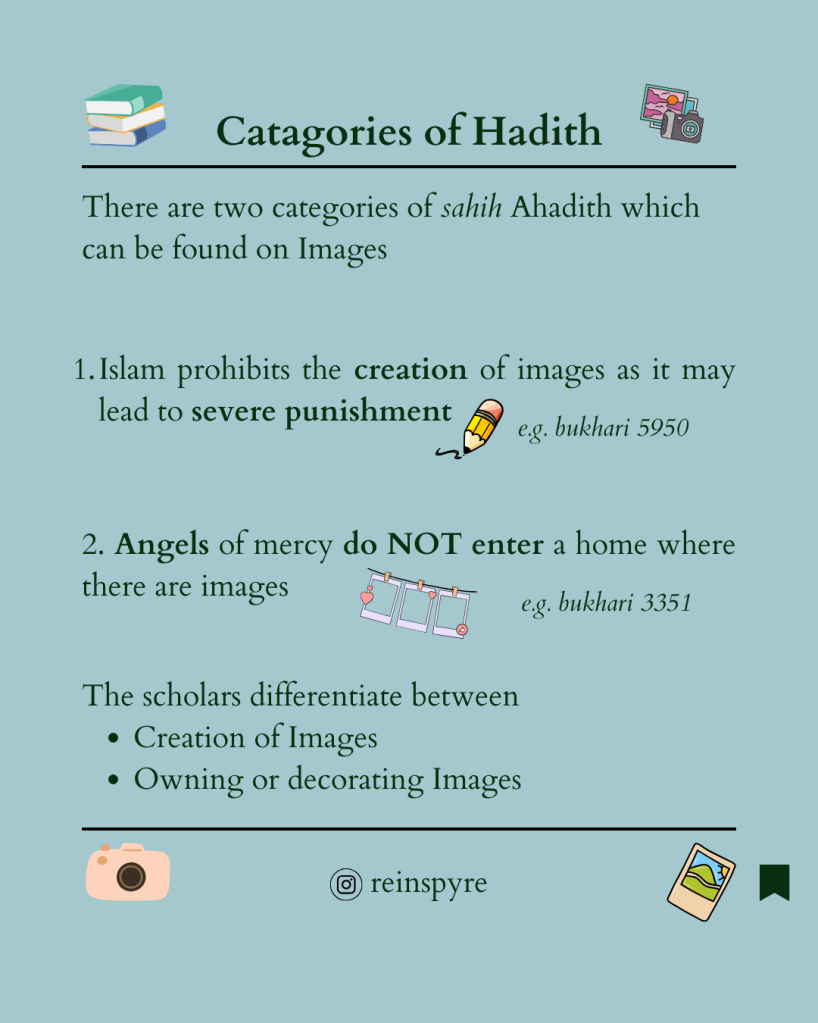
Two categories of Hadith
| Ruling | Consequence | |
| 1 | Prohibition of creation of images | Severe punishment in the hereafter |
| 2 | Owning or decorating home with images discouraged | Angels (of mercy) do not enter the home |
Images in Quran
There is no explicit mention of prohibition of making or owning images in the Quran
- The word تمثال is mentioned in the Quran. The Jinn used to make sculptures for Suleman (peace be upon him) (Quran 34:13)
The Tabi’ Abu al ‘Aliyah (أبو العالية) said that in their sharia it was allowed to have statues
Images in Sunnah
The creation of images (صَوَّرَ) of humans or animals is forbidden
Creating: can mean drawing, sculpturing, etc. This does not include images/video captured with a camera
The Prophet (ﷺ) said
- “The people who will receive the severest punishment from Allah will be the picture makers” (bukhari 5950)
- “Whoever makes an image will be commanded on the Day of Resurrection to breathe the soul into it but he will not be able to do so.” (bukhari 5963) (an nasai 5360) (an nasai 5358)
- “The makers of these images will be punished on the Day of Resurrection, and it will be said to them: ‘Breathe life into that which you have created.” (bukhari 7557) (bukhari 7558) (an nasai 5361)
- “Whoever makes an image will be punished until (he is commanded) to breathe a soul into it, and he will not be able to do so.” (an nasai 5359)
- “Whoever fashions an image, he will be punished by Allah until he breathes into it – meaning the soul – and he cannot breath (a soul) into it.” (tirmidhi 1751)
The Prophet (ﷺ) commanded Ali to obliterate Images (تمثال) (muslim 969a)
The Prophet (ﷺ) objected to photos of Prophets in Kaaba (صُورَةٌ) (bukhari 3351)
Angels do not enter the House where there are Images (صُورَةٌ) or (تَمَاثِيلُ)
These ahadith are about Angels of mercy
The Prophet (ﷺ) said
- “Angels do not enter a house in which there are pictures” (bukhari 3351) (bukhari 3322) (bukhari 5949) (muslim 2106a) (muslim 2112) (an nasai 4282)
- There are some exceptional cases where this is permissible e.g. the term “except designed in a garment” (إِلاَّ رَقْمًا فِي ثَوْبٍ) is used in Hadith. (muslim 2106d 2106e) (an nasai 5350 sahih) (an nasai 5349 sahih) (abi dawud 4155 sahih) (tirmidhi 1750 sahih)
- Many scholars believe that this is only applicable for the venerated 2d images or any 3d animate entity sculptures in the house.
- There are examples of early Tabiyun who owned home items like cushions, etc with images on them. E.g. Scholars such as Salim who is the son of Abdullah ibn Umar and grandson of Umar or Al Qasim ibn Abi Bakr who studied with his aunt Aisha (he was grandson of Abu bakr). It was seen as permissible because these images were not venerated
Removal of Curtain/Cushion with Images (صور)
- A curtain with images on it made the Prophet (ﷺ) angry. He said “Such people as paint these pictures will receive the severest punishment on the Day of Resurrection“ (bukhari 6109)
- A curtain with pictures on it was seen by the Prophet (ﷺ) and he asked for it to be removed. The exact words were “Remove it from my sight, for its pictures are still coming to my mind in my prayers” (bukhari 5959)
- A cushion with images was disapproved by the Prophet (ﷺ). He said “The makers of these pictures will be punished on the Day of Resurrection, and it will be said to them, ‘Give life to what you have created (i.e., these pictures).’ ” The Prophet (ﷺ) added, “The Angels of (Mercy) do not enter a house in which there are pictures (of animals)” (bukhari 5181)
- A curtain with horses and wings was not allowed (muslim 2107d) (an nasai 5352)
The turning of Curtain into Garments for Cushion (تَمَاثِيلُ)
- Narrated `Aisha: Allah’s Messenger (ﷺ) returned from a journey when I had placed a curtain of mine having pictures over (the door of) a chamber of mine. When Allah’s Messenger (ﷺ) saw it, he tore it and said, “The people who will receive the severest punishment on the Day of Resurrection will be those who try to make the like of Allah’s creations.” So we turned it (i.e., the curtain) into one or two cushions. (bukhari 5954) (muslim 2107i)
- Also see another narration with similar message but the word of image is not explicitly there (abi dawud 4153 sahih)
- Notice that another hadith didn’t allow the images on cushions, however, reconciliation between the two Ahadith is easy, because it is very possible that the images on the pillows in the first were elaborate and obvious, whereas in this case, and particularly after cutting the curtain up, the images became irregular and insignificant
Scholars’ View
Wisdom behind Image Prohibition
Generally scholars believe that images and sculptures lead to idol worship and ascribing partners with Allah (شِركْ). This is most likely the reason why this is not permissible
Drawing / Creating Images
- 3d: The scholars of the four madhabs agree that 3 dimensional carving of animate entities is forbidden (haram)
- 2d: According to Hanbali, Shaf’i and Hanafi school, the drawing of animate entities in 2-dimensions is also forbidden (haram)
- Imam Malik was of the opinion that all the hadith about curse and impermissibility are about 3d images only. His school made it Makruh to draw 2d images
Owning of or Decorating with Images
- Owning a 3d sculpture of animate beings is not allowed
- Owning a 2d picture/painting made by someone else has multiple opinions by scholars. Those who allow it make a condition
- The picture is not placed on a place of esteem or veneration
Leaving Matters of Doubt
The Prophet (ﷺ) said
- “Leave what makes you in doubt for what does not make you in doubt. The truth brings tranquility while falsehood sows doubt” (tirmidhi 2518 sahih)
- “Leave that which makes you doubt for that which does not make you doubt.” (an nasai 5711 sahih)
Trading of Idols (الأَصْنَامِ)
- The Prophet (ﷺ) forbade from trading idols and alcohol (bukhari 2236) (muslim 1581a)
This means that even buying is forbidden as it is part of trading
Camera Photos & Videos
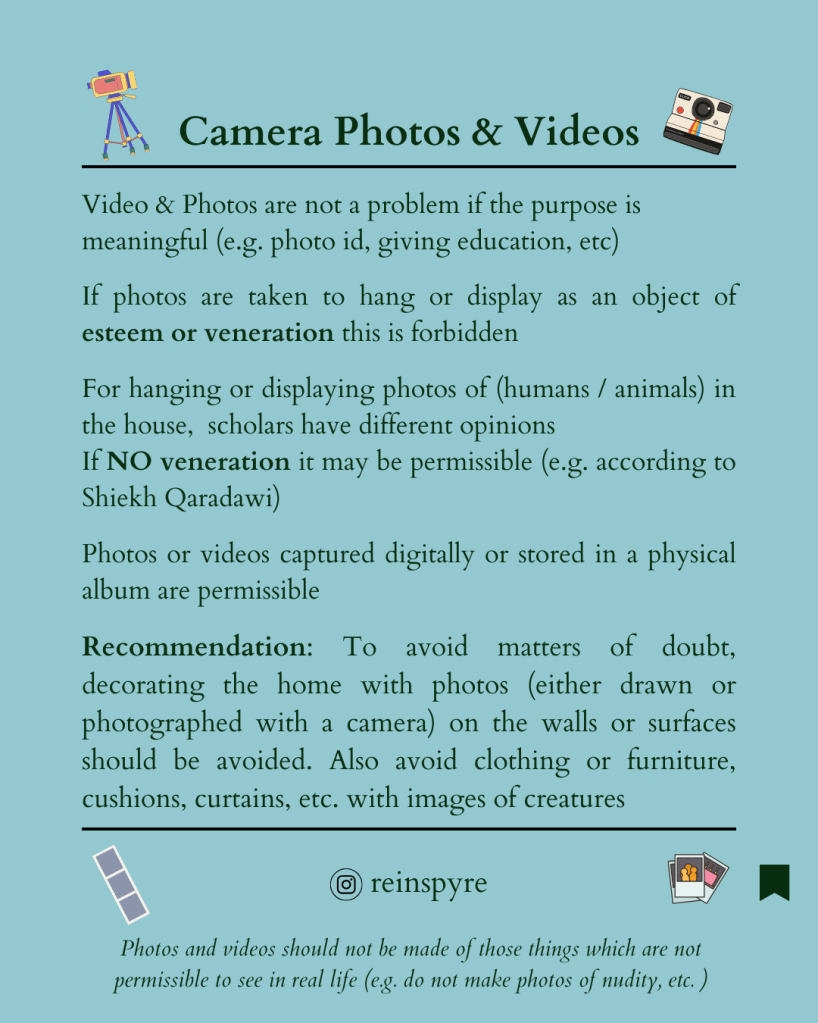
Video & Photos are not a problem if the purpose is meaningful (e.g. photo id, giving education, memories, etc)
But if they are taken to hang or display as an object of esteem this would be impermissible
Photos and videos should not be made of those things which are not permissible to see in real life (e.g. do not make photos of nudity etc)
If the photo is private in an album printed or soft copy in the phone, hard drive (e.g. Ibn ‘Uthaymeen allowed hard disk storage, but not printing), it is no problem as long as it is not shared with non-mahram
Whether the photos are hanging or decorated in the house, there is a difference of opinion from the scholars. As long as veneration is not there, it may be permissible according to some scholars (e.g. Shiekh Qaradawi)
Recommendation: In order to avoid matters of doubt, decorating the home with photos (either drawn or photographed with a camera) on the walls or surfaces should be avoided as much as possible
Mirror
The Mirror has also been used at the time of the Prophet and this is allowed. The image of a human exactly as it is, is not problematic
Praying with or around an image
- If there is a silhouette of polo or lacoste in the shirt, this is not a problem
- If there is a t-shirt with a clear big print out image, the scholars say it is makruh (should be avoided) but prayer should be acceptable
- Once the Prophet (ﷺ) prayed, he asked the image be removed from surrounding as it was distracting him (bukhari 374) (bukhari 5959)
Recommendation: Avoid clothing, curtains, garments, etc with images of animate beings. Silhouettes may be acceptable, but clearly printed images of humans and animals should be avoided
Images on money
- It is permissible to own money with images on them
- The coins used by the Prophet (ﷺ) and the Sahaba had images. The gold dinars were from the Byzantine empire and the Silver dirhams were from the Persian sasanian empire. Those had faces on them
- Abdul Malik ibn Marwan minted a coin with his own image (while Sahaba were still alive). This coin was in circulation. The future coins were then created with the kalima
- Sahaba or the tabiyyun had rings with images of humans on them which they used to seal letters
Cartoons
Scholars say that children can watch cartoons. There is no element of respect there, but it’s better to avoid drawing the eyes or nose (according to ibn ‘Uthaymeen see here)
Also photos for education may also be permissible. E.g. photos of people for teaching medical students, or teaching children names of animals with images, etc
Children toys of Animate beings
Children also play with toys and this is permissible. Even though toys may be a sculpture of a living thing. Usually, children do not see toys as objects of esteem, they play with toys and throw them around
- Our mother Aisha had a horse with wings. And this was allowed (abi dawud 4932)
Who are Angels of Mercy
Al-Nawawi (may Allah have mercy on him) said:
The scholars said: The reason why they do not enter a house in which there is an image is because it is a grievous sin, and it is competing with the creation of Allah, may He be exalted, and some of them are images of things that are worshipped instead of Allah, may He be exalted.
With regard to these angels who do not enter a house in which there is a dog or an image, they are the angels who go round with mercy, blessings and prayers for forgiveness. With regard to the recording angels, they enter every house and never leave the sons of Adam under any circumstances, because they are enjoined to list and record their deeds. End quote.
Also, the angel of death cannot be prevented by having images in a place
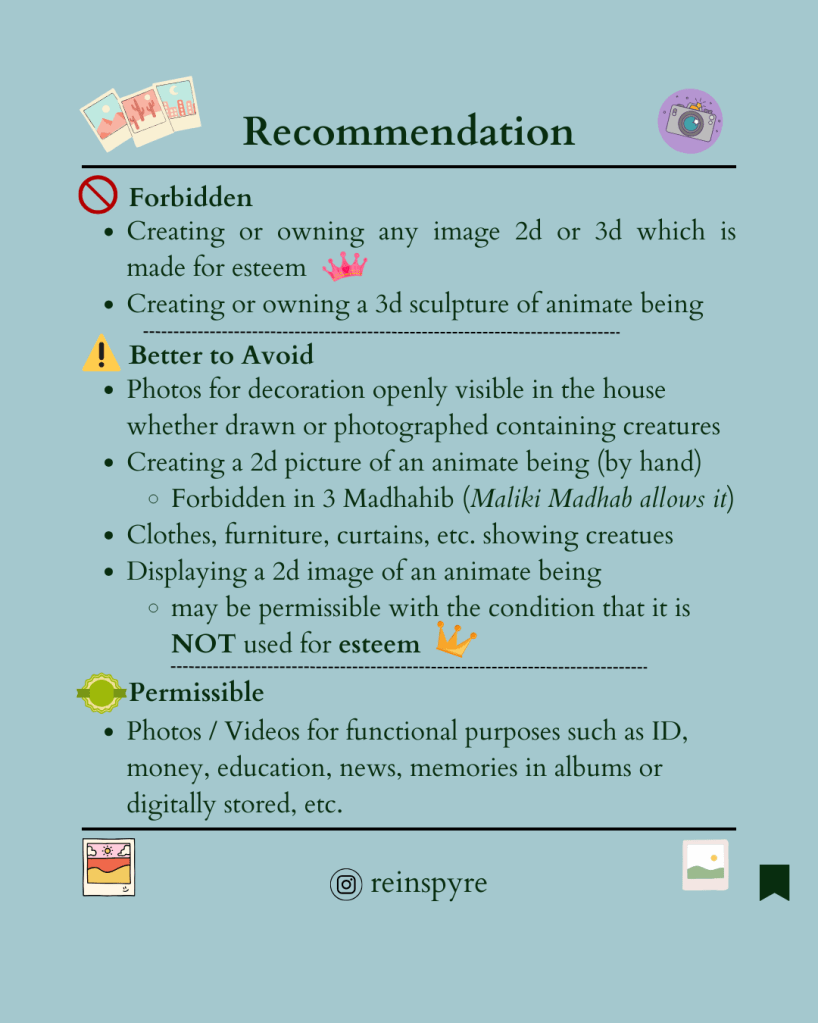
Recommendations Summarised
Forbidden
- Creating or owning any image 2d or 3d which is made for esteem
- Creating or owning a 3d sculpture of animate being
Better to Avoid
- Images or photos for decoration openly visible in the house whether drawn or photographed with creatures on them
- Creating a 2d picture of an animate being (by hand)
- Forbidden in 3 Madhab (Maliki Madhab allows it)
- Displaying or decorating a 2d image of an animate being
- may be permissible with the condition that it is not used for esteem
- Also avoid clothing or furniture, cushions, curtains, etc. with images of creatures
Permissible
- Photos / Videos for functional purposes such as ID, Money, Education, News, memories in albums or digitally stored, etc.
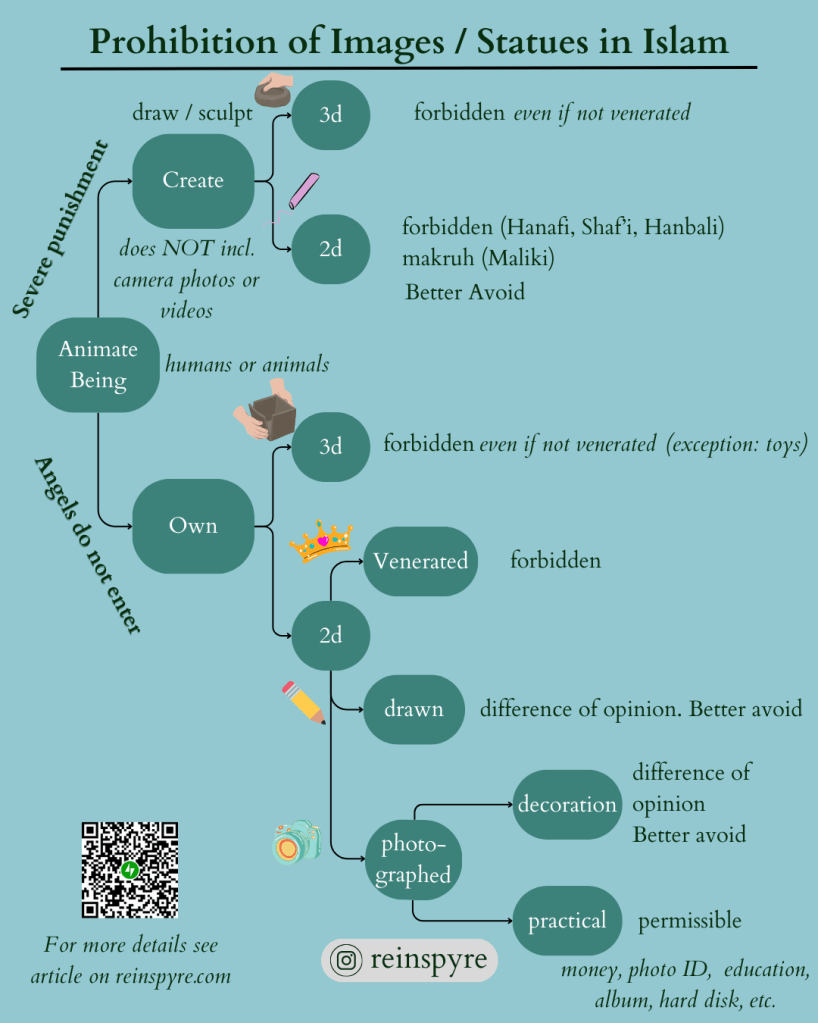
Tree Diagram
Glossary
| Term | Singular | Plural |
| Image | صورة | صور |
| Image or Photo | تَصويرٌ (if without tanween, it can also mean the act of portraying) | تَصَاوِيرُ |
| Sculpture / Figurine | تمثال | تَمَاثِيلُ |
| رَقْمًا فِي ثَوْبٍ | an expression in hadith which can be translated to “design in a garment”. It refers to situations where images may be allowed. These usually refer to small insignificant pictures that are on garments that are walked or reclined on, and not treated respectfullyExample see (muslim 2106d 2106e) |
Additional Reading
- Images, Statues and Pictures by Shiekh Dr. Hatem al Haj
- Is Drawing and Displaying Pictures Prohibited in Islam? Shaykh Dr. Yasir Qadhi
- Which Angels do not enter the homes
- Permissibility of Cartoons which do not contain haram elements
- Permissibility of money with images
- There is a hadith in Musnad Ahmad that image is concentrated in the face (described by Yasir Qadhi – could not find the reference)
 Reinspyre