

reading time ~35mins


- What is Consciousness
- Matters of the unseen
- Allah knows you better than you
- Human Beings in Islam
- Moments of increased consciousness
- Taqwa (تقوى) God-Consciousness
- Creator vs Creation
- Quotes
- Additional Reading
What is Consciousness
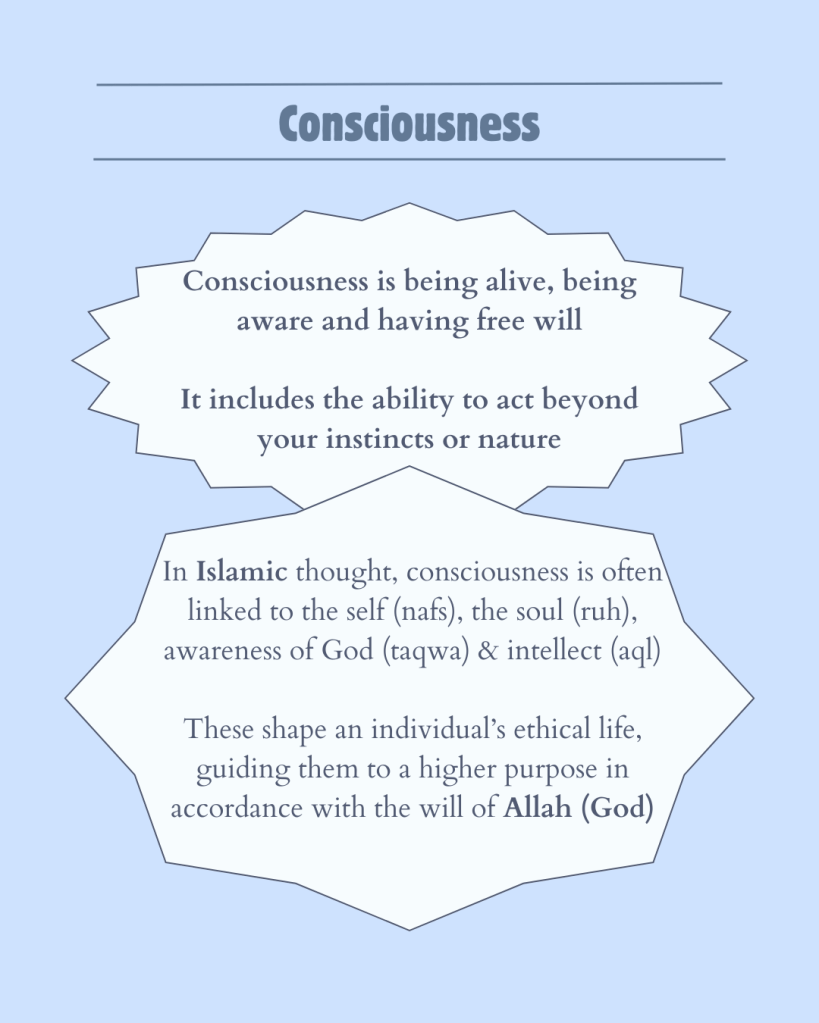
Consciousness is being alive, being aware and having free will. It includes the ability to act beyond your instincts or innate nature
In Islamic thought, consciousness is often linked to concepts such as the self (nafs), the soul (ruh), awareness of God (taqwa), intellect (aql), and self-awareness. These elements shape an individual’s spiritual and ethical life, guiding them toward a higher purpose in accordance with the will of Allah (God).
Compared to other ideologies, the goal of Islam is not to focus on consciousness too much. The essence of Islam is in oneness of Allah, messengers sent with guidance, upholding justice, God consciousness, welfare of the creation, day of judgement and the Afterlife
Every individual makes an effort to have good intentions and good deeds. The purpose is to attain God consciousness to enter paradise in the afterlife. We happily accept the fact that we do not fully understand consciousness or the soul
Matters of the unseen
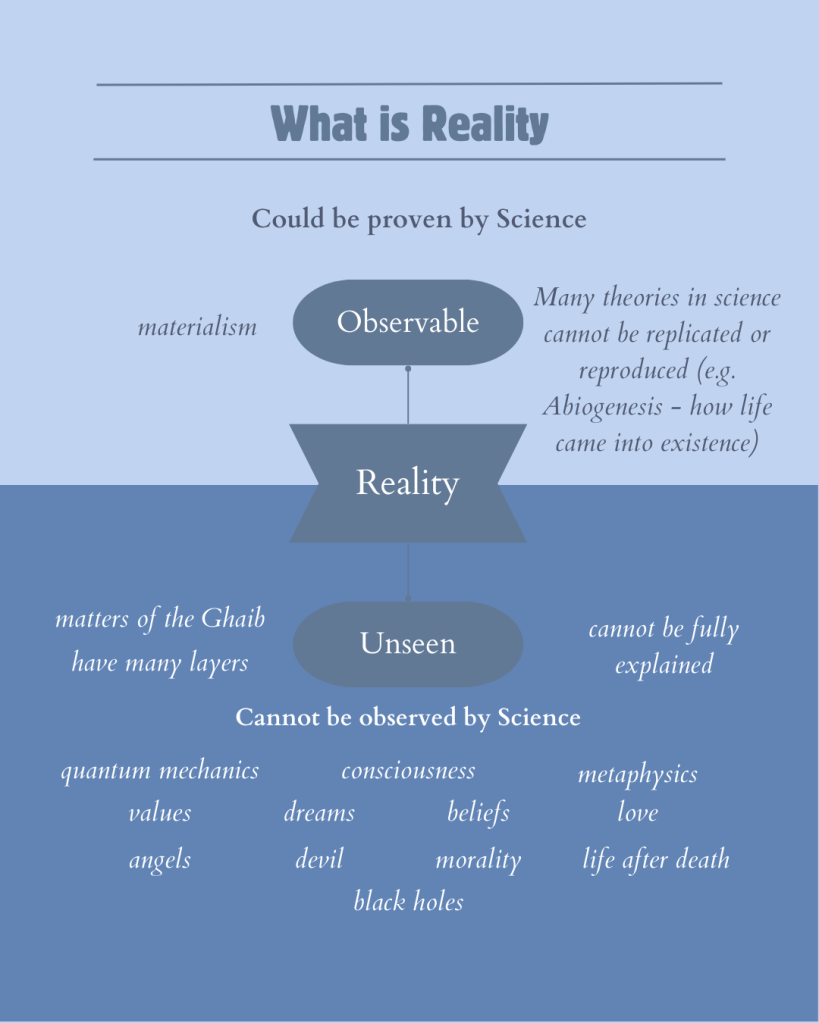
- Materialists and sophists came with the idea that only material is real
- There are things of the unseen like consciousness which cannot be observed
- Materialism cannot explain consciousness
- Quantum physics cannot explain consciousness.
- Abiogenesis (how life came into existence) or theory of evolution (how life evolved after coming into existence) cannot explain consciousness
Allah knows you better than you
- “Whether you speak openly ˹or not˺, He certainly knows what is secret and what is even more hidden.” (Quran 20:7)
- Even more hidden is part of yourself that Allah knows better than you
- “And do not be like those who forgot Allah, so He made them forget themselves. It is they who are ˹truly˺ rebellious.” (Quran 59:19)
- Those who remember Allah and are close to Allah – will be more aware of themselves
- The one who got to know his Master truly got to know himself. Arabic Saying
Human Beings in Islam
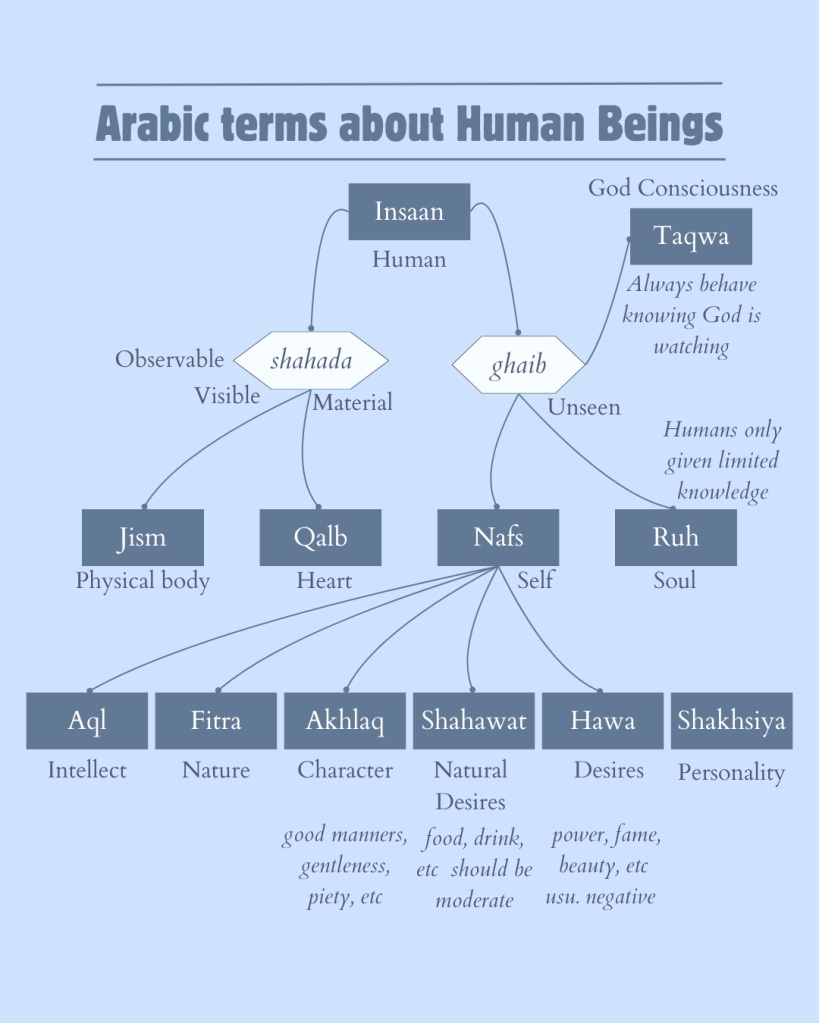
Human beings are composed of several parts
Fitra (فطرة) Innate Nature
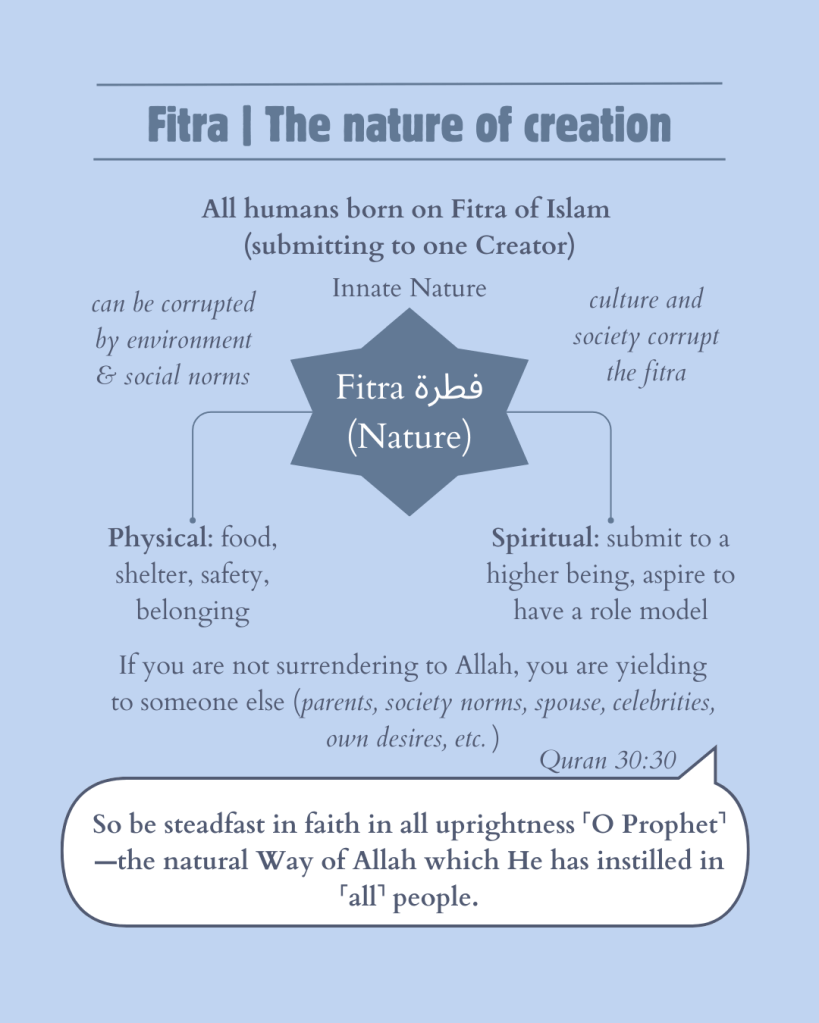
- Fitra is the nature of creation as the original, uncorrupted state of human beings, as designed by God at the moment of their creation
- Nature describes what creation needs to survive or be happy
- The fitra of a plant describes how much water and sun it needs
- Fitra of human is
- Physical: food, shelter, safety, belonging. These things should have quality as well. Junk food will not satisfy fitra because it is unhealthy
- Spiritual: submit to a higher being, aspire to have a role model, thank the one who does a favour, etc.
- If you are not surrendering or submitting to Allah, you are submitting or yielding to someone else (Parents, Society norms, Spouse, celebrities, own desires, etc) – it is natural to follow some system
- Fitra is concerned with the unseen – the Ruh (soul)
- All Humans are born with Islam in their Fitra
- Allah says in the Quran “So be steadfast in faith in all uprightness ˹O Prophet˺—the natural Way of Allah which He has instilled in ˹all˺ people. Let there be no change in this creation of Allah. That is the Straight Way, but most people do not know.” (Quran 30:30)
- The Prophet ﷺ said that everyone is born on fitrah of Islam but parents and society corrupt it (bukhari 1358) (bukhari 1359) (bukhari 1385) (bukhari 4775) (bukhari 6599) (muslim 2658b) (muslim 2658e) (abu dawud 4714)
- Culture of humans, social norms and environment can corrupt the Fitra. Plants and animals stay in correct fitra because of lack of culture
- It is in Fitra to worship one Creator, to love beauty, to seek justice, to seek pleasure, to avoid pain, etc
Root of the word Fitra
The root word of fitra (فطرة) in Arabic is “فطر” (faṭara). This root carries the fundamental meaning of “to create” or “to originate.” The word fitra is derived from this root and refers to the natural disposition or innate nature with which human beings are created. In Islam, fitra is often understood as the innate predisposition towards goodness and the belief in the oneness of God (tawhid)
Nafs (نفس) Self
- Nafs is the inner self, personality, psyche or ego
- It is mostly a worldly being
- Is unseen and undetected in the physical world. It is lateef (subtle)
- Nafs separates humans from all other creation living or non living
- Nafs will perish (Quran 3:185) (Quran 21:35)
- كُلُّ نَفْسٍۢ ذَآئِقَةُ ٱلْمَوْتِ
- Nafs is attributed to humans – The ayaat below use the word Nafs
- When evil befalls you it is from yourselves (Quran 4:79)
- You are yourself sufficient against yourself as a reckoner on this day (Quran 17:14)
- On the other hand, the Ruh is attributed to Allah (to give honour to the Ruh. The Ruh is also a creation and not a part of Allah)
- Nafs has desires such as to eat, drink, gain resources & land, etc. It wants a beautiful spouse, tasty food, nice house, etc. The desires can be physical things amongst others
- Desires of Nafs are like a horse which need to be controlled
- Three types of Nafs (all three exist in everyone and change at times depending on deeds)
- Nafs al Mutmayyina (satisfied) with worshipping Allah. Voluntarily knows and does the right thing and surrenders to Allāh peacefully. It is content without conflict (Quran 89:27-28)
- Nafs al Lawamma (injured) in the middle doing good and bad then good. Always criticising itself. It is in conflict and feels guilty after sin (Quran 75:2)
- Nafs al Ammara bissu (commands) doing evil deeds (Quran 12:53)
- Different pursuits of nafs
- Cattle: physical (bahemi) drives like animals such as eating, drinking, playing
- Predator: drives like killing, usurping, destroying competition, etc
- Satanic: drives like iblis such as arrogance, delusion, love to be leader, deceit, shirq, lying, cheating
- Angelic: drives to do good deeds and learn knowledge (ilm) to create nearness and love for Allah and return back to origin
- Nafs is mentioned many more times (x295) in Quran compared to Ruh being mentioned (x21)
- Nafs is generally called the Self. It can be said to be composed of or linked to
- Ruh
- Aql
- Body
- We do not fully understand relationship between Nafs and other parts of the human being such as Ruh
Root of the word Nafs
The root word for nafs (نَفْس) in Arabic is “نفس” (n-f-s). This root carries meanings related to “breath,” “soul,” “self,” or “life.”
The reason nafs is derived from this root is tied to the idea of the self or soul being closely connected to the essence of life and breath. In many languages, the concept of breath is metaphorically linked to life or the inner essence of a person. In Arabic, this connection is literal, as the word nafs encompasses both the idea of the breath that sustains physical life and the deeper, spiritual aspect of a person’s being
The root n-f-s (نفس) is also used in the context of نَفَس (nafas), which directly means “breath” in Arabic. This usage highlights the essential and vital aspect of nafs as it relates to life and existence.
Here’s how the word is used in a simpler, everyday context:
Nafas (Breath): When someone is talking about taking a breath, they use the word nafas (نَفَس). For example, “He took a deep breath” would be “أخذ نَفَسًا عميقًا” (Akhadha nafasan ʿamiqan).
In this context, nafas (breath) is directly connected to life. Just as breath is necessary for physical survival, the nafs is seen as the essence or life force of a person. Without breath, there is no life, and similarly, the nafs represents the inner self or soul that animates the body
Ruh (روح) Soul
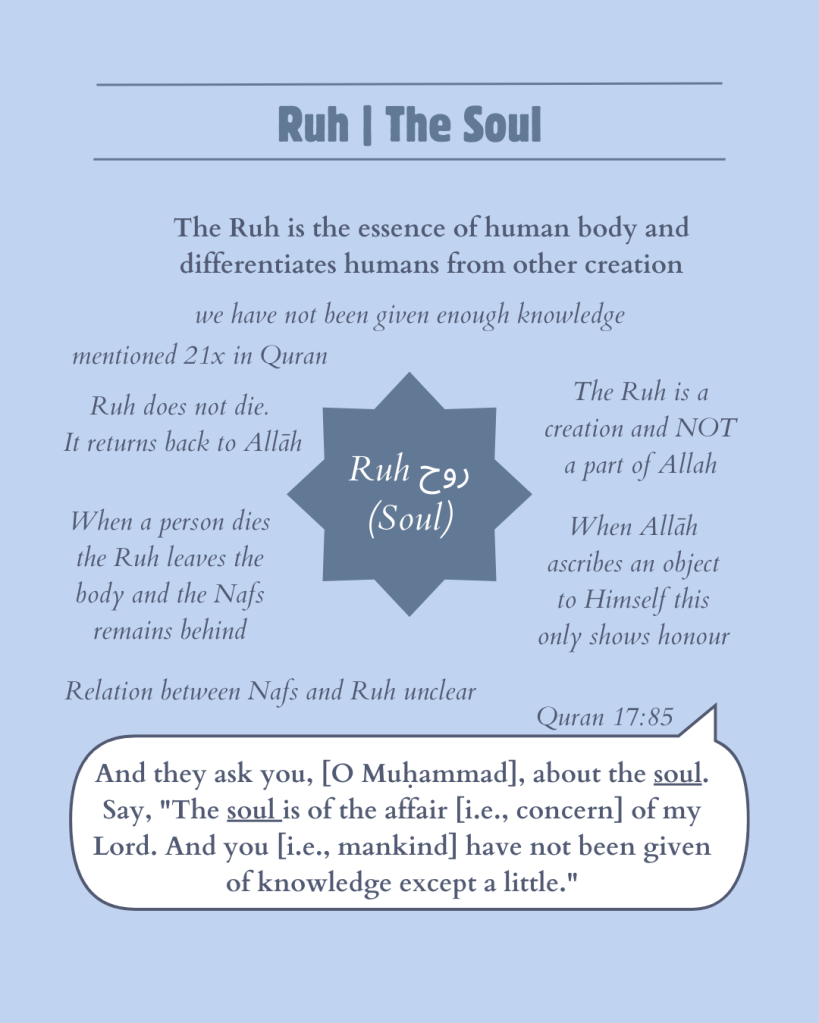
- Ruh is the soul. The Ruh is the essence of human body and differentiates humans from other creation
- Ruh is Amr (command) of Allāh
- Allah attributes the Ruh to Himself (Quran 4:171) (Quran 15:29) (Quran 21:91) (Quran 38:72)
- We don’t have enough knowledge as humans about the Ruh
- And they ask you, [O Muḥammad], about the soul. Say, “The soul is of the affair [i.e., concern] of my Lord. And you [i.e., mankind] have not been given of knowledge except a little.” (Quran 17:85)
- On the other hand the Nafs is attributed to the human
- Ruh is a creation (and not part of Allah as some sufis may think) but it has a connection with Allah which we don’t understand fully
- Ruh is made of light. It is part of fitra and is light of the heart
- Angel Jibraeel عليه السلام is called Ruh and angels are made of light
- Ruh leaves body when we sleep (Quran 6:60) (Quran 39:42)
- Revelation is the food of Ruh
- Ruh does not die. It returns back to Allāh
- Dhikr of Allah brings tranquillity to hearts (which seems to affect the Ruh) (Quran 13:28)
- Purpose of life comes from Ruh
- When an evil act is done, guilt is felt by Ruh. Although society/customs can lead you to misunderstand what to feel guilty about
- The Ruh and Body cannot exist outside the mothers womb without the Nafs
- When a person dies and Ruh leaves the body then Nafs remains behind
- The real difference only Allāh knows. We just have interpretations from the Scholars (Ulama)
- Sometimes Nafs is used in place of the Ruh. E.g In hadith when the Nafs leaves the body the eyes follow it (muslim 920a) (ibn majah 1454)
- The Ruh is not a ghost that exists inside the body that moves out or so. That is a cartoonic oversimplification
- Whether or not two people find it easy to get along in this world has something to do with their Ruh being close to each other or not. Ruh are like recruited soldiers. Those with like qualities are inclined to each other (bukhari 3336) We do not and cannot fully comprehend how this works
The word Ruh is also used in Quran for
- Jibraeel (Angel Gabriel) عليه السلام
- Quran or revelation is called Ruh
- Ruh was blown into Maryam (Mary) عليها السلام
- Isa (Jesus) عليه السلام is called Ruh from Allāh
- Help from Allāh coming to Sahaba (Companions)
- Ruh is soul inside the body
Ruh is divine help which brings life either as revelation, Angel etc.
The Ruh is a creation and NOT a part of Allah
- And [mention, O Muḥammad], when your Lord said to the angels, “I will create a human being out of clay from an altered black mud. And when I have proportioned him and breathed into him of My [created] soul, then fall down to him in prostration.” (Quran 15:28-29)
- When Adam عليه السلام was created. Allah blew His (created) Ruh into Adam. This does not mean that human Ruh is part of Allāh. It also does not mean that there is divinity in human Ruh. This is a false concept followed by an old religion called Gnosticism
- When Allāh ascribes an object to Himself this only shows honour. It does not make it divine. E.g the kaaba is the house of Allāh but it is a creation and it is not divine. The Ruh is also a creation.
Root of the word Ruh
The root word for rūḥ (رُوح) in Arabic is “روح” (r-w-ḥ). This root is associated with meanings related to “spirit,” “breath,” “soul,” or “wind.”
The connection between rūḥ and its root “روح” (r-w-ḥ) lies in the concept of the spirit or soul being akin to a life-giving force, much like breath or wind. In many languages and cultures, breath is often metaphorically linked to the essence of life, and in Arabic, rūḥ captures this idea as the immaterial, life-giving aspect of a human being.
The root r-w-ḥ is used in the word رِيح (rīḥ), which means “wind” in Arabic. This connection between rūḥ (spirit) and rīḥ (wind) illustrates the intangible, unseen, but powerful force that both wind and spirit represent.
Here’s how the word rīḥ is used in a simpler context:
Rīḥ (Wind): When someone talks about the wind, they use the word rīḥ (رِيح). For example, “The wind is strong today” would be “الرِيح قوية اليوم” (al-rīḥ qawiyya al-yawm).
In this context, rīḥ (wind) is something that cannot be seen, yet its effects are felt strongly. It moves things, carries sounds, and can be gentle or powerful. Similarly, rūḥ (spirit) is an unseen force within a person, vital for life and deeply influential, even though it is intangible.
This everyday example of rīḥ (wind) helps convey the essence of rūḥ (spirit) by highlighting the invisible yet essential nature of both wind and spirit in the world.
Qalb (قلب) Heart
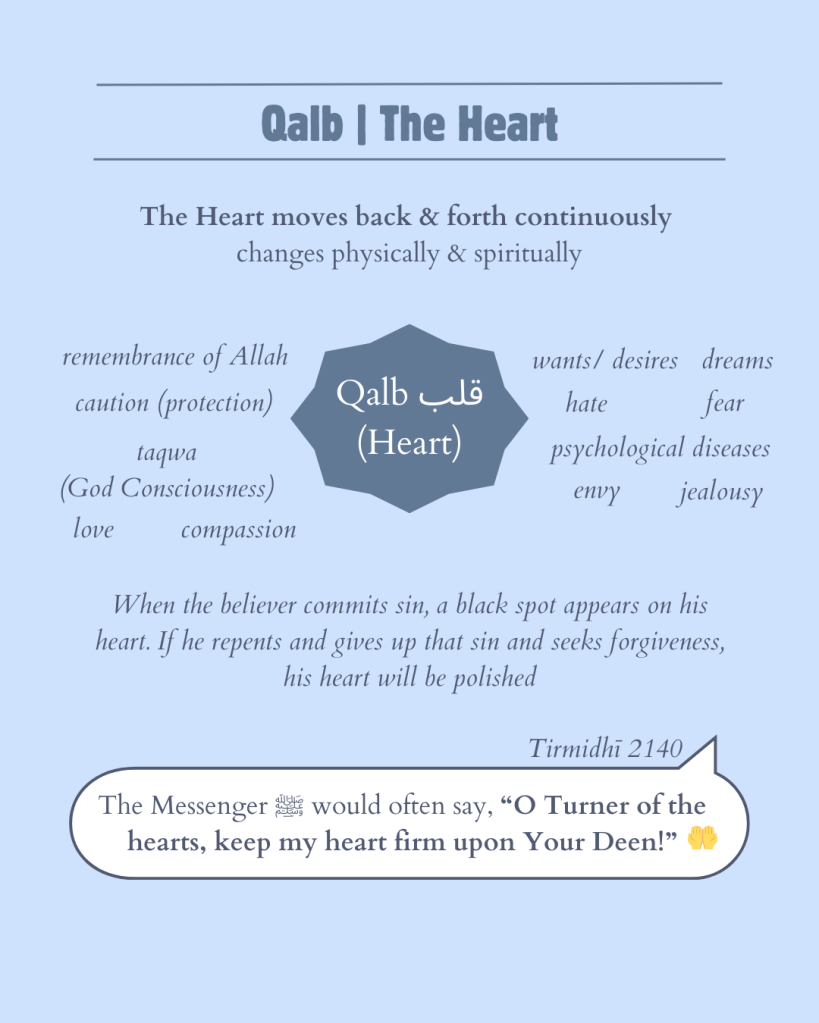
- The Qalb moves back and forth continuously
- Describes the heart which continuously keeps changing physically and spiritually
- Prophet ﷺ used to regularly make Dua to keep the heart steadfast on the deen (tirmidhi 2140)
- ” يَا مُقَلِّبَ الْقُلُوبِ ثَبِّتْ قَلْبِي عَلَى دِينِكَ ”
- Qalb is strongly related to the Nafs and Fitra (original light in the heart) – we do not fully understand how
- Qalb has emotions
- Qalb has
- Remembrance
- Caution (protection/Taqwa/Awareness of God)
- Love
- Empathy
- Compassion
- Dreams
- Wants/ Desires
- Psychological diseases
- Fear
- Hate
- Jealousy / Envy
- Seeing (Sama’a) and hearing (basara) are used to receive information for Aql or Qalb. Qalb has the final verdict to accept or reject
- Remembrance (Dhikr) of Allah brings tranquility to hearts (Quran 13:28)
- When the believer commits sin, a black spot appears on his heart. If he repents and gives up that sin and seeks forgiveness, his heart will be polished. (ibn majah 4244 Grade: Hasan) (tirmidhi 3334 Grade: Hasan)
- When the Qalb is hurt or goes through trauma then Aql starts asking questions (sometimes ridiculous ones). At this point some people will leave faith because Qalb is hurt
- Qalb is not just the physical but also the spiritual (Subtle/Lateef). Even the physical is much more than a pump
Sickness of the Qalb
- Heart is sick when it doesn’t perform its function. Function of the Qalb is to seek knowledge (‘ilm) which leads to deep love for and nearness to Allah
Root of the word Qalb
The root word for qalb (قَلْب) in Arabic is “قلب” (q-l-b). This root is associated with meanings such as “to turn,” “to flip,” “to change,” or “to transform.”
Aql (عقل) Intellect
- Aql is intelligence. It is to hold on to something with a leash
- Having emotional or egoistic bias means you are not using Aql. Aql is to hold back and the ability to restrain yourself from Falsehood (batil)
- Aql is a mind free from desires, feelings, emotions, sadness etc thinking clearly
- Aql is
- Understanding
- Thought/reflection
- Recognition/ Remembering
- Realisation
- Learning/ Knowledge
- Also see Qalb
- Seeing (Sama’a) and hearing (basara) are used to receive information for Aql or Qalb. Qalb has the final verdict to accept or reject
- Allah asks in the Quran several times ‘why do you not use your Aql to contemplate or reason’’
- أَفَلَا تَعْقِلُونَ (Quran 12:109)
Root of the word Aql
The root word for ʿaql (عَقْل) in Arabic is “عقل” (ʿa-q-l). This root is associated with meanings related to “to bind,” “to restrain,” “to reason,” or “to comprehend.”
The root ʿa-q-l (عقل) was originally used to describe the action of binding or restraining, particularly in the context of tying or hobbling a camel or a horse to prevent it from wandering off
Hawa (هَوَى) Whims
- Nature: Hawa refers to base desires, whims, and capricious inclinations that can lead one away from righteousness and the path of Allah. It often implies a negative connotation, suggesting desires that are in conflict with reason, morality, and divine guidance
- Implications: Following one’s hawa is generally discouraged in Islam because it can lead to moral and spiritual corruption. It is seen as an obstacle to achieving true faith and obedience to Allah
- Examples: Pursuing selfish interests at the expense of others, giving in to irrational and harmful urges, or acting on fleeting impulses without consideration for Islamic teachings
- Allah says in the Quran
- Have you seen he who has taken as his god his [own] desire (Quran 45:23)
- Have you seen the one who takes as his god his own desire? Then would you be responsible for him? (Quran 25:43)
- Indeed, the Hour is coming – I almost conceal it – so that every soul may be recompensed according to that for which it strives. So do not let one avert you from it who does not believe in it and follows his desire, for you [then] would perish. (Quran 20:15-16)
- The word hawa is used as desire in Arabic in these Ayaat
Shahawat (شَهَوَات) Physical Desires
- Nature: Shahawat refers to natural human desires and appetites, such as the desire for food, drink, sexual relations, and other physical and material needs. These desires are not inherently negative and are considered a normal part of human life
- Implications: While shahawat are natural, Islam teaches that they should be moderated and fulfilled in permissible (halal) ways. The goal is to balance these desires with spiritual and ethical responsibilities, ensuring they do not lead to sinful behavior
- Examples: The desire for marriage and intimacy (fulfilled within the bounds of marriage), the craving for food and drink (satisfied through halal means), and the pursuit of wealth (achieved through honest and ethical work)
| Hawa | Shahawat | |
| Moral and Spiritual Context | Hawa is often associated with desires that lead one away from Islamic principles and towards wrongdoing, | while Shahawat are natural desires that, if regulated properly, can be fulfilled within the framework of Islamic law |
| Guidance and Control | Islam emphasizes controlling hawa and ensuring it does not dominate one’s actions | In contrast, shahawat are to be managed and satisfied in ways that align with Islamic ethics and teachings |
| In summary, while both hawa and shahawat pertain to human desires, hawa generally represents negative, capricious inclinations that can lead one astray, whereas shahawat are natural desires that need to be fulfilled in a balanced and permissible manner | ||
Moments of increased consciousness
There are moments when we may experience increased consciousness
- When we wake up but still half asleep
- When we are walking or showering or emptying dishwasher
- Alcohol, drugs or psychedelics may increase consciousness but generally forbidden in Islam
All thoughts are not from own Consciousness
- All human beings receive whispers from two possible unseen companions.
- Angels may encourage to do good (al-Sunan al-Kubrā lil-Nasā’ī 10624 grade: Hasan)
- Satan whispers to do evil (and we seek refuge in Allah) (muslim 2814)
- but these are not part of consciousness
Taqwa (تقوى) God-Consciousness
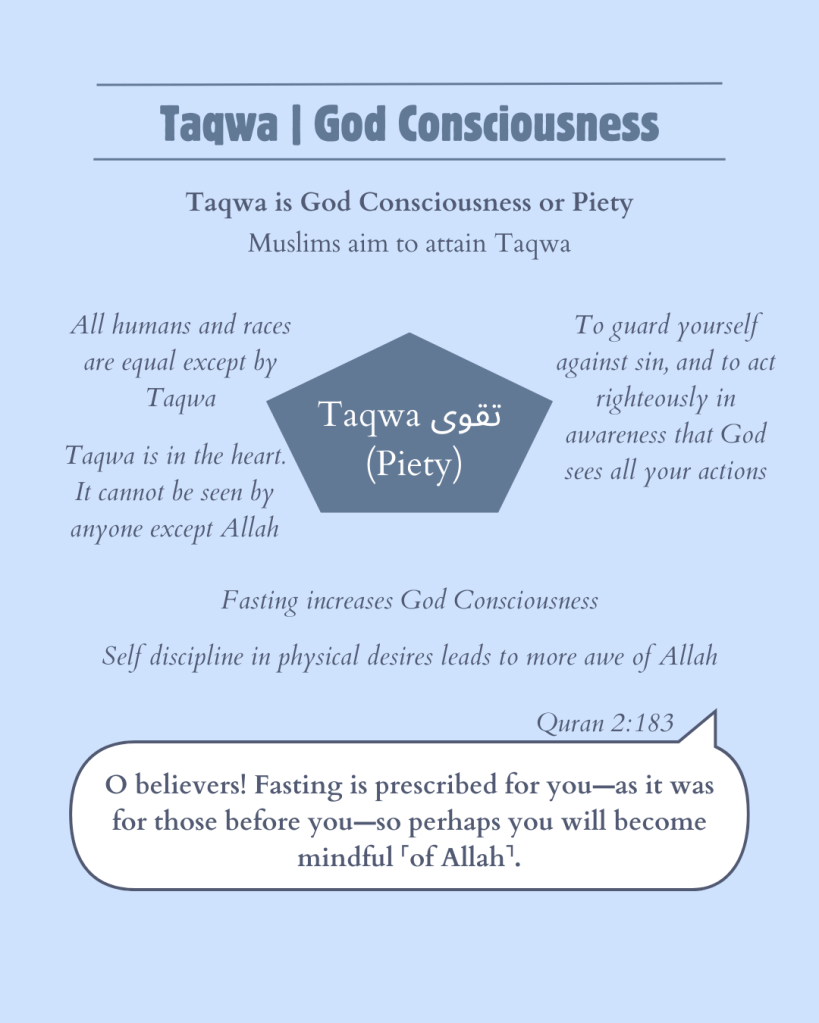
- Taqwa is translated as God Consciousness or Piety
- One of the primary goals in Islam is for human beings to attain Taqwa
- It is to guard yourself against sin, and to act righteously in public and in private in awareness that God exists, sees and is fully aware of all your actions
- No race, ethnicity or skin colour is superior to another. All humans and races are equal except by Taqwa (Piety or God-Consciousness). (musnad Ahmad 23489, 21407, 22978, 20885)
- Taqwa is in the Qalb (heart). It cannot be seen by anyone except Allah (muslim 2564a)
- Fasting increases Taqwa (God Consciousness)
- “O believers! Fasting is prescribed for you—as it was for those before you—so perhaps you will become mindful ˹of Allah˺.” (Quran 2:183)
- There is a strong correlation between being hungry and being aware of God.
- Self discipline in case of physical desires leads to more awareness and awe of Allah
- A believer comes close to Allah first by doing obligatory deeds (prayer, fasting, zakat, Hajj, etc) then by doing voluntary deeds (bukhari 6502)
- Taqwa is attained by doing deeds as commanded by Allah (rather than human beings coming up with what is good or evil)
- Ihsan (Excellence) is to act as if Allah is watching you (bukhari 50)
Root of the word Taqwa
The root word for Taqwa (تقوى) comes from the Arabic triliteral root و ق ى (waqā), which means “to protect,” “to guard,” or “to shield.” In the context of Islam, Taqwa refers to having God-consciousness or piety, where one guards oneself against sin out of reverence and awareness of God’s presence
Pre-Islamic Usage Example
Before the advent of Islam, the word from the root و ق ى was used in everyday Arabic to refer to protection or shielding from harm or danger.
For example, in pre-Islamic Arabic poetry or conversation, a person might say:
وقيت نفسي من الأذى (waqītu nafsī min al-adhā) — meaning “I protected myself from harm.” In this context, the word “waqītu” comes from the same root and refers to physically guarding oneself or taking preventive action against danger, such as using a shield in battle.
This idea of protection from harm was later spiritualized in Islam, where Taqwa means to guard oneself from moral and spiritual harm by living according to God’s guidance.
Creator vs Creation
There is a clear difference in Islam between ‘The Creator’ and ‘creation’. We do not believe that God is part of or comparable to anything
Creator
The Creator is perfect, ever living, all powerful, independent, all knowing, all wise, sees and hears everything. Has no partners or equals. No creation can comprehend ‘The Creator’ fully
Creation
The creation has a beginning, is contingent, has weaknesses
Quotes
Know thyself
Socrates
Knowing yourself is the beginning of all wisdom
Aristotle
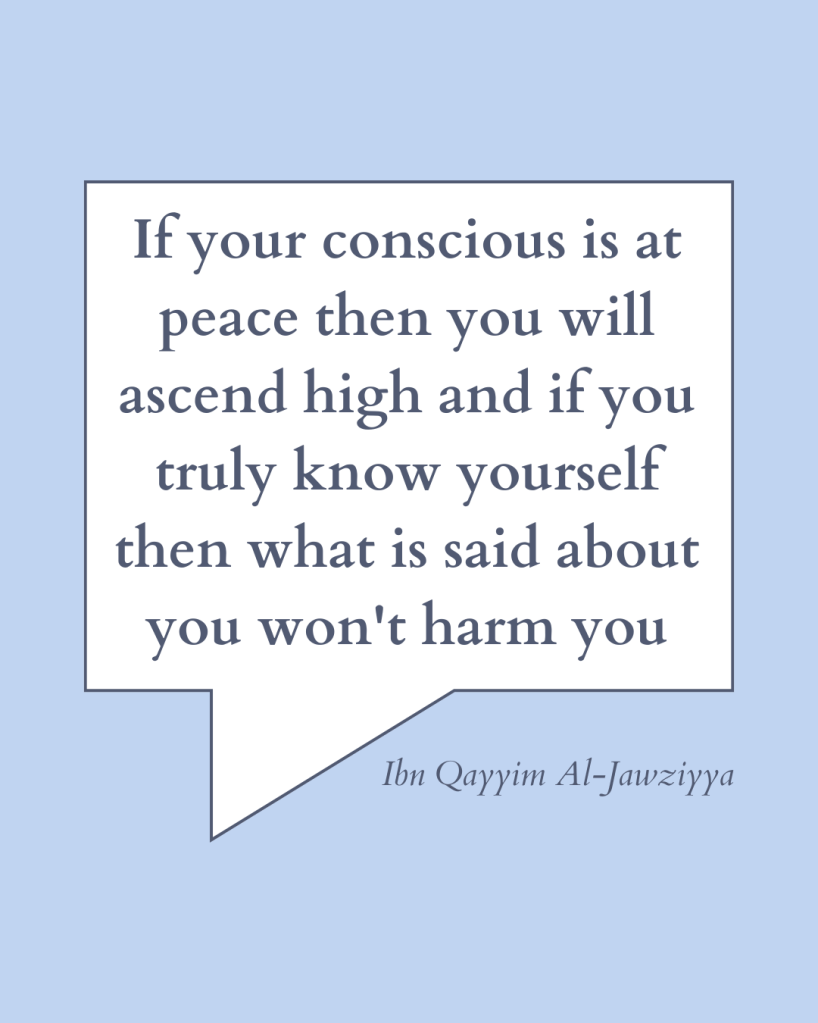
If your conscious is at peace then you will ascend high and if you truly know yourself then what is said about you won’t harm you
Ibn Qayyim Al-Jawziyya
Reality is merely an illusion, albeit a very persistent one
 Reinspyre