
reading time ~8 mins
- Introduction
- Terminology
- Some Observations from the Report
- Important Graphs & Figures
- Here are some tips for individuals
- Additional Reading
Introduction
Anti-Muslim sentiment (also: anti-Muslim racism) refers to the attribution of sweeping, largely unchangeable, backward, and threatening characteristics to Muslims and people perceived as Muslim. This can be caused by unconscious bias (e.g. due to ingroup and outgroup thinking, influence of mainstream media or generalization of a group based on isolated experiences, etc.) It can be felt in the private environment (e.g. apartment hunting) or in the workplace (recruitment, engagement in meetings, etc.)
There are ~5.5 million Muslims who live in Germany today. Worldwide there are ~1.9 billion Muslims (25% global population). The number is projected to keep increasing
The Federal Ministry of Interior & Community (BMI) in Germany has published an independent report (developed over a period of ~2.5 years) which highlights anti-Muslim sentiments in Germany in great detail
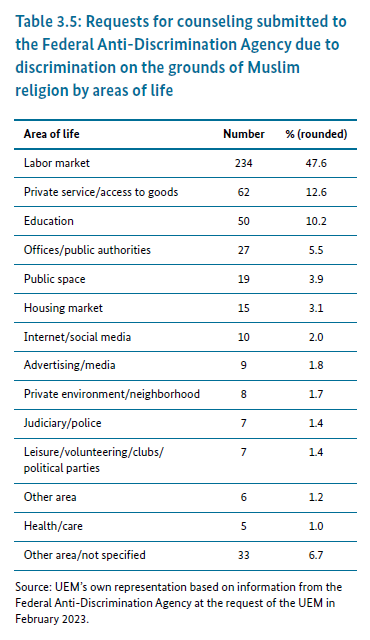
When someone is a victim of racist behaviour, sometimes they think it is their fault. It’s important to remember that discrimination is not acceptable. This can be raised with the Federal anti discrimination agency here
Unfortunately, this continues to be a challenge even today. I have personally also experienced statements like “does Islam really belong in Germany?“, “go back where you came from” or “crime has increased after immigration from arab countries” which tend to stereotype & generalise the entire group based on one off incidents or mainstream media propaganda. Sometimes it’s very subtle such as making remarks about the sense of dressing, headscarf or style of beard of individuals
Terminology
The English term “islamophobia” is used internationally and was established by the British think tank Runnymede Trust (see 1997). However, this term was quickly criticized for, among other things, falsely suggesting that anti-Muslim attitudes are “exaggerated feelings of fear and not consequential resentments” (Pfahl-Traughber 2019). In the German context, on the other hand, the term “Islamfeindlichkeit” (anti-Islam sentiment) soon became established. (p.22-23)
Runnymede Trust (1997): Islamophobia. A Challenge for Us All. Report of the Runnymede Trust Commission on British Muslims and Islamophobia. London: The Runnymede Trust.
As a Muslim I find the term Islamophobia strange, demeaning & offensive whereas the terms ‘anti-Muslim racism’ or ‘anti-Muslim sentiment’ seem more appropriate
Some Observations from the Report
Equal participation of all people is the central mandate of the democratic constitutional state and a widely shared expectation in society and state institutions. Non-discriminatory and respectful interaction in everyday life is equally important. This also applies to the Muslim population as one of the most pressured minorities in Germany. (p.18)
- Around every second person in Germany agrees with anti-Muslim statements (p.8)
- Muslims are perceived not only as particularly “alien” immigrants but also as members of an allegedly “backward” religion (p.8)
- Muslim women describe how they are not perceived as self-determined. Men, on the other hand, tend to be labelled as aggressive and violent (p.9)
- Islam and Muslims still appear in primarily negative contexts in major German media (p.10)
- A comprehensive analysis of the portrayal of Islam in German- language films, for instance, shows that almost 90 percent of the films examined have a negative thematic reference (p.13)
- The legal system of the Federal Republic of Germany, for instance, is rooted in historical developments that were aligned with the circumstances and expectations of a society that was religiously rooted in Christianity (p.6)
- The “othering” (us vs them) (see subchapter ↗ 2.3) is a widespread phenomenon that affects not only Muslims but also other marginalised groups (p.18)
- Facts and figures are captured in chapter 3 (p.39-71)
- Comparison of anti Muslim sentiments across Europe (p.51)
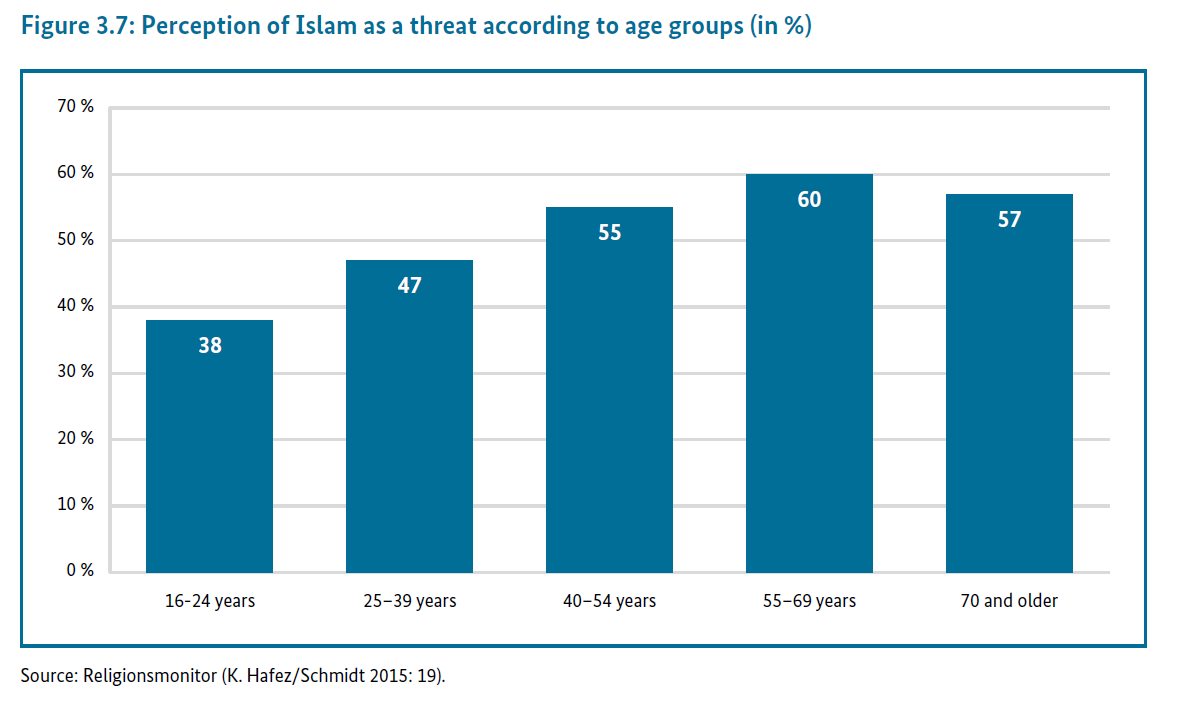
- Perception of Islam as a threat according to age group in Germany (p. 54)
Important Graphs & Figures

p. 51
p.54
P.66
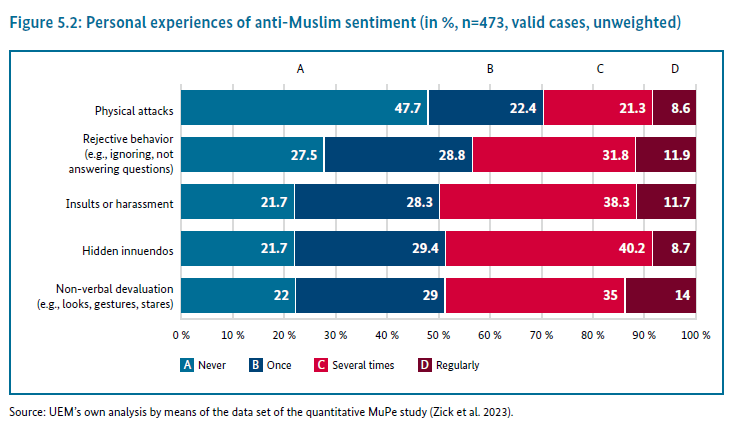
P.110
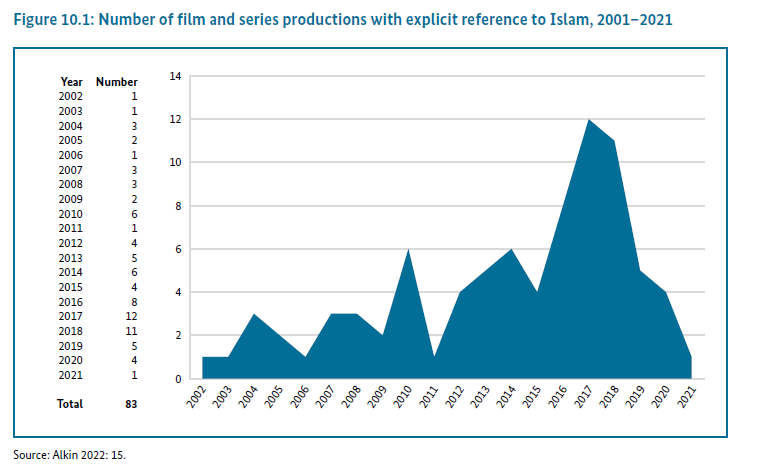
P.281
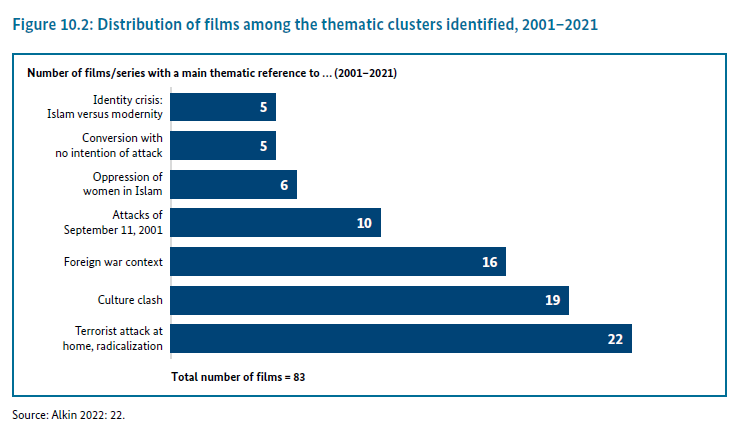
p.282
Here are some tips for individuals
- We can avoid to generalise ~5.5 million people in DE (or ~1.9 billion people in the world) based on the actions of a few individuals
- We can learn about Muslim values, culture & traditions by doing own research & study
- We can travel to Muslim lands to learn about how the locals live there
- We don’t have to believe everything we hear in the news or mainstream media
- We keep an open mind to appreciate the nuances of cultures & religions which are unfamiliar to us
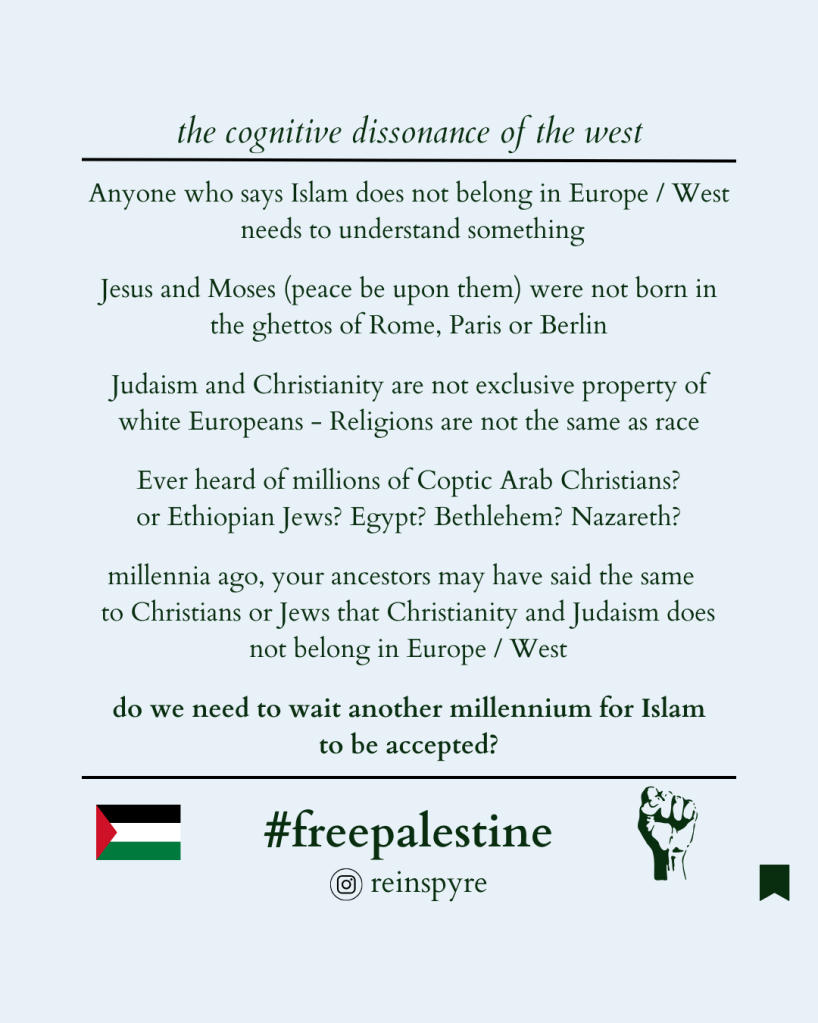
- We should remember that Christianity & Judaism also originated in the Middle east. At some point (millennia ago) they were also foreign in Europe. It is today, that they are part of European society for a while with large number of followers in comparison to Islam
Most Importantly, Islam cannot necessarily be seen as a physical characteristic. Islam is neither genetic nor a culture, race, nation, or ethnicity (e.g. not all Arabs or South Asians are Muslims). Islam is very inclusive and all races, nations or ethnicities can enter into Islam to become Muslims
Additionally, All humans and races are equal in Islam except by piety. And piety cannot be seen since it lies in the heart and only known to God
There are also recommendations on institutional, political & legal levels which need to be implemented to create a more inclusive society which can be found in the study
Please feel free to read the report or reach out to me for any questions
Thank you for your attention
 Reinspyre
One response to “Anti-Muslim Sentiment in Germany”
I wish there were a way to discuss the very real effects of cultural f’ear (I use the apostrophe to break the word apart and make it less toxic). So far there is much ignorance (state of ignoring) each other when both seem to have so much to offer. Intolerance goes both ways in my observations- we are all looking to have the other prove to us we’re “wrong” about prejudice.
our reflection of a given reality is just that – our a mirrored projection – so perpetrating indignity lies with the individual.
To keep naming anti- this or – phobia that, crystallizes and institutionalizes – hence strengthens a difficult situation, In other words, naming something solidifies the state – it doesn’t dissolve it which is my goal (so there is a greater sense of unity and cooperation- not just for me, but for an “us”. Our (in the US – or in Germany (I lived there for several years) educational system of course doesn’t help -it adds to divisiveness, haves and have-nots.
there are now no bona fide ways, with teachers and tutors to get people to work together. (Of course my “souk” essay on drjenwyman-clemons.com addresses that but so far readership is unimpressive).
I don’t want to receive notifications about constant anger and frustration – it makes me wonder about day-to-day people in my life who look like this or that – makes me prejudge them. Mainstream media is making polarity worse too.
Blessings.
LikeLike